Lakeland is a small, largely residential town in northeast Shelby County, shaped almost entirely by master-planned neighborhoods rather than any real commercial core. An investor considering Lakeland for a 1031 replacement should expect a market that looks a lot like Arlington next door: real rooftop growth, minimal standalone commercial inventory.
A Residential Town With Thin Commercial Stock
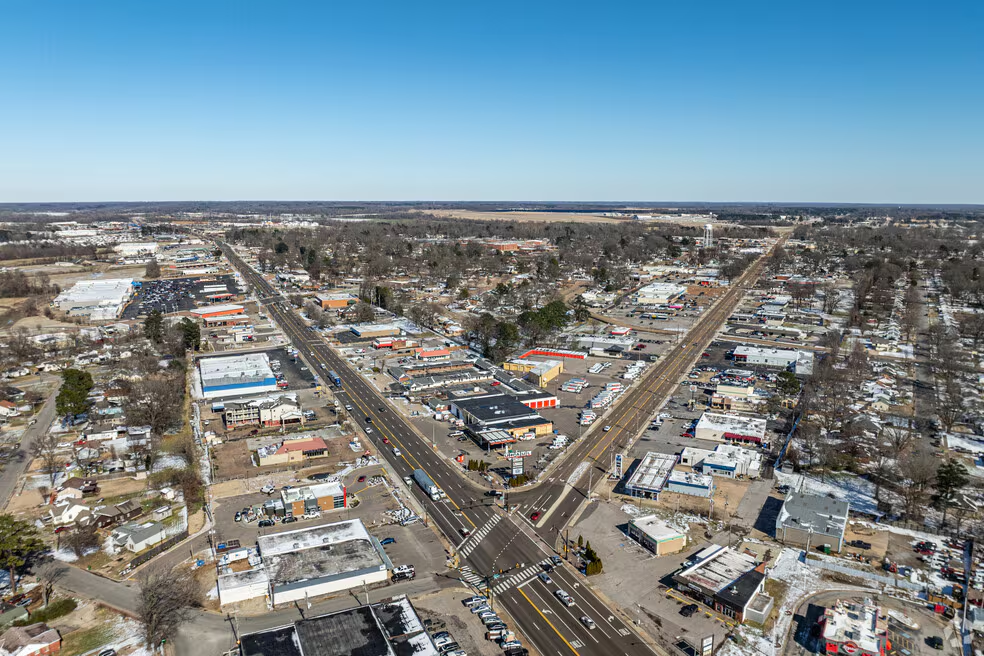
Most of Lakeland's growth over the past decade has been single-family and master-planned residential, concentrated along Canada Road and the US-70 corridor. Commercial development has followed at a much slower pace, leaving a handful of small retail centers and single-tenant sites to serve a population that mostly commutes to Bartlett, Cordova, or Memphis for larger shopping and services.
That imbalance is worth naming plainly: Lakeland can support a 1031 exchange, but usually only as part of a broader search that also includes Arlington or Bartlett, since Lakeland alone rarely produces enough distinct candidates to fill an identification list.
What Realistically Exists To Buy In Lakeland
The commercial inventory that does exist in Lakeland falls into a short, honest set of categories.
- small neighborhood retail centers serving nearby subdivisions
- single-tenant pads along Canada Road and the US-70 corridor
- self-storage facilities built to serve new residential growth
- small professional office space tied to local practices
What A Generic Lakeland Quote Leaves Out
Because Lakeland sits so close to Arlington and Bartlett, some coordination proposals lump it into a single northeast Shelby County scope without distinguishing between the towns' actual inventory. That glosses over a real difference: Lakeland's residential focus means even less standalone commercial product than Arlington, and a quote that doesn't separately flag Lakeland's scarcity is understating the backup-candidate risk.
It's also common for a generic scope to skip verifying whether a candidate's utility and access infrastructure has kept pace with Lakeland's rapid residential growth, since some of the town's commercial parcels sit at the edge of recently extended service areas.
Building A Realistic Search Around Lakeland
Given how thin the standalone inventory is, the practical move is to build the identification list across Lakeland, Arlington, and the Bartlett line from the start rather than waiting to see what turns up in Lakeland alone. Utility and access verification should happen early in diligence for any Lakeland candidate near the edge of the town's newer development areas.
What A Lakeland Candidate File Should Contain
A Lakeland retail or office candidate should come with confirmation of when water, sewer, and electric service were extended to the parcel, since some of the town's commercial sites sit at the edge of recently developed subdivisions where service extensions are newer than the building itself. A current traffic count for Canada Road or US-70 at the property's specific frontage should also be requested, since Lakeland's overall traffic volume is still modest compared to Bartlett or Cordova and an investor should confirm the number actually supports the intended tenant use.
Because so much of Lakeland's population is recent, occupancy and rent trends should be reviewed over the shortest realistic window, typically two to three years, rather than a longer history that may not reflect current demand. An investor should also ask directly whether any nearby residential phases are still under construction, since additional rooftops delivered after closing can meaningfully change the tenant demand a small Lakeland center is underwritten against. School enrollment trends are worth a quick check too, since Lakeland's own school system is still relatively new and continued enrollment growth is one of the clearer signals of durable rooftop demand feeding the town's small commercial base. Because so few standalone commercial buildings exist in Lakeland, an investor should also confirm whether the seller has ever operated the property as anything other than its current use, since a change in use can sometimes trigger a fresh permitting review with the town.
Common 1031 Exchange Questions
Is there enough commercial property in Lakeland for a 1031 exchange on its own?
Usually not enough to fill an identification list alone, since Lakeland's growth has been almost entirely residential; most investors pair a Lakeland search with candidates in Arlington or Bartlett.
What property types exist in Lakeland?
Small neighborhood retail centers, single-tenant pads along Canada Road and US-70, self-storage facilities, and small professional office space make up most of the realistic inventory.
How is Lakeland different from Arlington for a replacement search?
The two towns are similar in scale, but Lakeland's commercial stock is even thinner given how residential its recent growth has been, so a search should not assume the two markets offer equivalent inventory.
Should utility infrastructure be checked on a Lakeland candidate?
Yes, particularly for parcels near the edge of newer development, since utility and access service in some of these areas has only recently been extended to keep pace with residential growth.
What backup markets pair well with a Lakeland search?
Arlington and the Bartlett corridor are the most common pairings, since both offer somewhat deeper commercial inventory within a similar distance of Lakeland.
How far back should occupancy history be reviewed for a Lakeland candidate?
Two to three years is usually more realistic than a longer trailing period, since so much of Lakeland's population and commercial activity is recent and an older history may not reflect current demand.
Should pending residential construction near Lakeland be checked before buying?
Yes. Additional rooftops delivered after closing can meaningfully change the tenant demand a small Lakeland retail or office center is underwritten against, so nearby construction phases should be confirmed directly.